Homepage


Research the Future: PhD Open Day at UniBO
An online event for those who have completed, or are about to complete, their degree and want to understand whether a PhD is the right next step for their future: how it works and the career opportunities it offers today.
Go to pageHIGHLIGHTED
-
Vedi dettagli
PhD scholarships: over 280 professional training development opportunities, funded by the NRRP
Closing date for applications: August 2, 2022 Go to page -
AMS Phd theses repository
-

3MT – Three Minute Thesis Competition: a challenge to PhD students
-
40th cycle (to start in academic year 2024-2025) - Call for applications
-
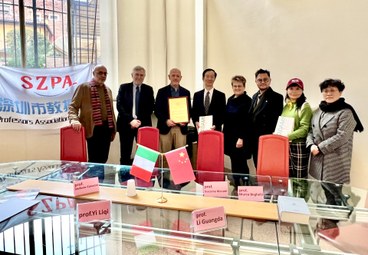
The Shenzhen Professors Association’s visit to the Department of Arts and to the PhD Programm staff.
-
Vedi dettagli
COVID-19 - The Measures Adopted by the University of Bologna
Select the link at the bottom to check the measures adopted by the University of Bologna to allow activities to resume safely. Go to page -
International PhD College

Migration information campaigns: qualitative research design and data analysis strategies
Josh Watkins, May 18, 2026, 10 am–1 pm, Room 20, Teaching Hub Forlì. Seminar on migration information campaigns as communication strategies to influence migrants. Focus on research design and qualitative analysis of content and discourse on visual and textual data.
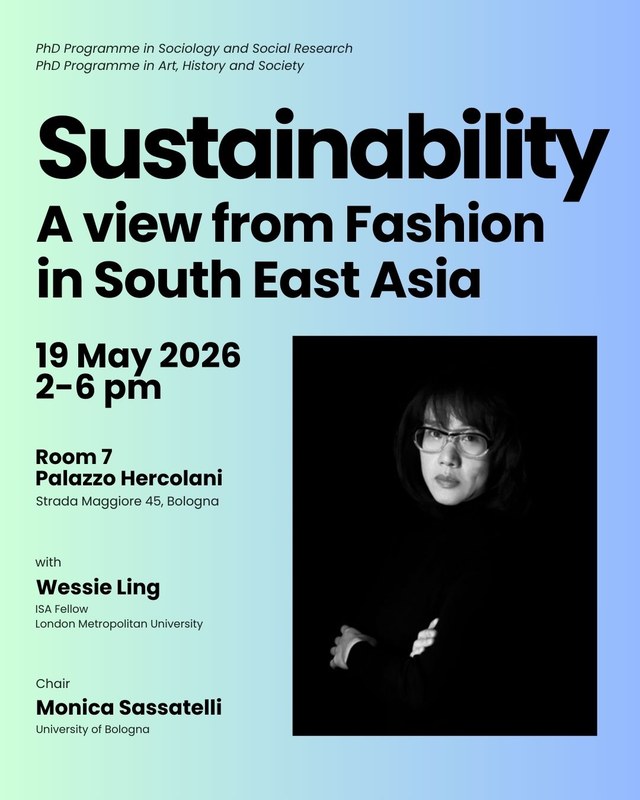
Sustainability. A View from Fashion in South East Asia
Seminar held in English. Monica Sassatelli opens with a presentation on the social and cultural history of the concept of sustainability. Wessie Ling will then provide an in-depth discussion of sustainability in the fashion sector, with particular reference to the South-East Asian context and based on her field research.
Fashion Heritage Unbound: Material Culture in the Dream Space
The study day Fashion Heritage Unbound explores the intersections between fashion, memory, and digital technologies, questioning the material and immaterial dimensions of contemporary sartorial heritage. Through contributions from scholars and professionals from international institutions, the event investigates how cinema, social media, and digital practices redefine the relationship between care, labour, and representation in fashion. The sessions will address topics ranging from the aesthetics of costume on screen to new forms of digital craftsmanship, up to the sensorial and political construction of fashion heritage in the media age.
The event, organized by the University of Bologna and Sapienza University of Rome with the support of the Cassini Project – French Embassy in Italy and the MICS (Made in Italy – Circular and Sustainable) programme, will take place on 3 November 2025 at Aula Camino, Palazzo Marescotti, Bologna.
What is the housing condition of students? Help us understand by filling out the questionnaire
Housing is a growing obstacle to education. The survey will help understand it, engage stakeholders, and push for concrete solutions.
Go to pageBecome a student community representative
Become a student community representative. Apply by 7 April
On 14 and 15 May, students will vote to elect their representatives to the University Governing Bodies. Step up and become the spokesperson for the needs and projects of our student community.
Software Development for Research and Reproducible In-Silico Experiments: Best Practices
The event is part of the Open Science Corner series. During the session, FAIR champion Danilo Pianini will discuss best practices for in-silico experiments and the importance of planning software development to ensure reproducibility. This free event is aimed at researchers. Fill out the form to participate on 19 March.
Go to pageSummer School Open Innovation Management for a Sustainable Transition
Apply now for the free Summer School focused on sustainable transition. Deadline: June 3.
Go to pageSummer School Climate Change: Artistic Interventions and Alternative Futures
The Summer School, which will last for 5 days, will be taught in English language. It awards 3 University educational credits (CFU) and has as its learning outcome to explore pressing issues related to climate change and the role of artists in proposing new social and economic dynamics that can have social and economic effects. Through an interdisciplinary approach involving professors from usually distant academic fields such as art history, economics and biology, a speculative approach will be developed, aimed at understanding the dramatic environmental condition that has taken shape with the emergence of the Anthropocene. In particular, the educational project moves from a reconsideration of cultural practices as a driver of social processes based on forms of public engagement, aimed at developing scenarios of futuristic societies that are at least as desirable as they are practicable.
Starting date: Jun 09, 2025
Finishing date: Jun 13, 2025
Application deadline: May 26, 2025 26 May 2025 at 1.00 p.m.
Selection date: 29 May 2025
Enrolment start and end: From 30 May 2025 to 05 Jun 2025
Pier Paolo D’Attorre Doctoral Thesis Award
A biennial award of €4,000 for doctoral theses on topics central to Pier Paolo D’Attorre, Professor of Contemporary History at the University of Bologna. Application deadline: 23 June.
Go to pageSpotlights
ANVUR Accreditation Visit 2025
How the visit works, its phases, and the actors involved.
Contributions for health costs for non-resident students
If you are a non-resident student you can apply for the competition to request contributions. Application deadline: 31 December.
Your Research in 3 Minutes
Applications are open for the Coimbra Group Three-Minute-Thesis Competition. If you're a final-year PhD student, you can present your research in English in just 3 minutes. Deadline: 17 December.
Phd Recruiting Day
On 10 February, take part in the event where public bodies and companies meet PhD holders to present job opportunities that match the skills they have acquired.
Are you interested in global sustainability? Join the Una Europa Virtual Exchanges for Sustainability (UnaVEx)
From 5 to 26 March, the multidisciplinary encounters include lessons on the topic of sustainability and ""Virtual Exchange"" activities, carried out in international groups. Registrations until 28.02.
Which Encyclopedias and Libraries for the Future
From 25 to 27 March, take part in the Seasonal School of the Collegio Superiore, focused on the tools of research and of scientific, cultural, and political production and communication.
Call for Papers DOCTORAL CONFERENCE SASPE 2026
Call for Papers
DOCTORAL CONFERENCE SASPE 2026
The Heritage of Healing: Art and Hospitals Throughout the Centuries
16-18 December 2026
Florence, Rettorato dell’Università degli Studi di Firenze, Piazza San Marco 4, Aula Magna.
Siena, Santa Maria della Scala, Piazza Duomo 1, sala San Galgano.
Pisa, Palazzo Boileau, Università di Pisa, via Santa Maria 85, Aula Magna.
The PhD candidates of the Course of History of Art and Performing Arts of the University of Florence, the University of Pisa, and the University of Siena (SASPE) are organizing the annual doctoral conference in collaboration with the teaching staff. This year, the title is The Heritage of Healing: Art and Hospitals Throughout the Centuries, and it is funded by the SAGAS Department, and the ERC ARCHIATER (Heritage of Disease: The Art and Architectures of Early Modern Hospitals in European Cities), in collaboration with Fondazione Santa Maria Nuova ETS of Firenze e Fondazione Antico Ospedale Santa Maria della Scala of Siena.
Hospital buildings were not only battlegrounds against diseases, epidemics and social vulnerability; they were also places where civic identities were constructed. Over the centuries, they witnessed an accumulation of patronage, artistic activity, and conservation, and became the backdrop for encounters between hospital and city life, where religion and symbolism met healthcare. As a result, while the needs of the patients were met, these places acquired distinctive systems of imagery.
The complex and layered function of hospital buildings led to architectural, artistic and symbolic inventions that were bound to the various necessities within those hospitals, such as the availability of places dedicated to caretaking, the separation of spaces reserved for the sick and those reserved for the hospital staff; the promotion of cults; the conservation of relics; the formation of representative areas of prestige, and the internal use of functional, practical objects such as hospital beds and ceramics marked with hospital logos. It would be reductive to hold the visual culture born from these necessities against the light of only the ruling class’ desire for self-representation; it should be considered in a wider view in which the intricate contexts of healthcare can be disclosed. Art and architecture for hospitals—for instance, the monumental building complexes, the decorative cycles, other paintings and sculptures, and liturgical and devotional objects—on the one hand contributed to the construction of an identity of the institutes themselves, relating to religious, political, and civic values, and on the other hand collectively proposed a wider idea of “monumentalizing” an institutionalized experience of human suffering over the centuries.
The conference The Heritage of Healing: Art and Hospitals Throughout the Centuries invites an interdisciplinary reflection on the evolving relationship between the heritage of hospitals, visual culture, and healthcare up to the present day. Its goal is to explore the significance of art, architecture and material culture for the history of healthcare, specifically the relative construction of civic identity, and the way in which this heritage is currently interpreted, conserved and valued.
We particularly encourage early career scholars, such as PhD candidates and graduate students, to apply, and we prefer interdisciplinary contributions that pursue a dialogue between objects, spaces, and healthcare systems, stretching over a long period of time, and that relate to the following subjects:
● Art, visual culture and decorative programs of hospital buildings.
● Iconography of sickness, healing, death and salvation.
● Architectural organization of hospitals and its relationship with urbanism.
● Artistic patronage and strategies of representation of charitable institutions.
● Material and immaterial heritage of hospitals.
● Dispersal, preservation and display of artworks with a provenance from hospitals.
● Change in function, conservation, and enhancement of hospital buildings.
● Curatorial strategies and the heritage of healthcare.
Application:
Abstracts of max. 2000 characters and a CV must be submitted in a single PDF with the name ‘Last Name’_’Name’_Heritage2026 before 31 July 2026 by mailing the document to patrimonidellacura@gmail.com with the mailing title ‘Application Conference Heritage of Healing - ‘name last name’. Candidates will be informed of a decision before 1 October 2026.
Contributions should be no longer than 20 minutes; the use of a PowerPoint is expected.
The primary language of the conference is Italian, but presentations in English are also welcome.
Please note: There is no registration fee for the conference; however, all travel, accommodation, and other expenses are the responsibility of the participants.
Scientific committee:
Faculty and PhD candidates of the Doctoral Program in History of Art and Performing Arts (SASPE) of the University of Florence, the University of Pisa, and the University of Siena.
Organizing committee:
Faculty: Prof. Andrea De Marchi and Prof. Chiara Franceschini
PhD Candidates: Floris de Beij, Alice Brocchini and Caterina Corsi